
Emerging Trends in Mindi Wood Custom Chairs for Global Furniture Markets 2026
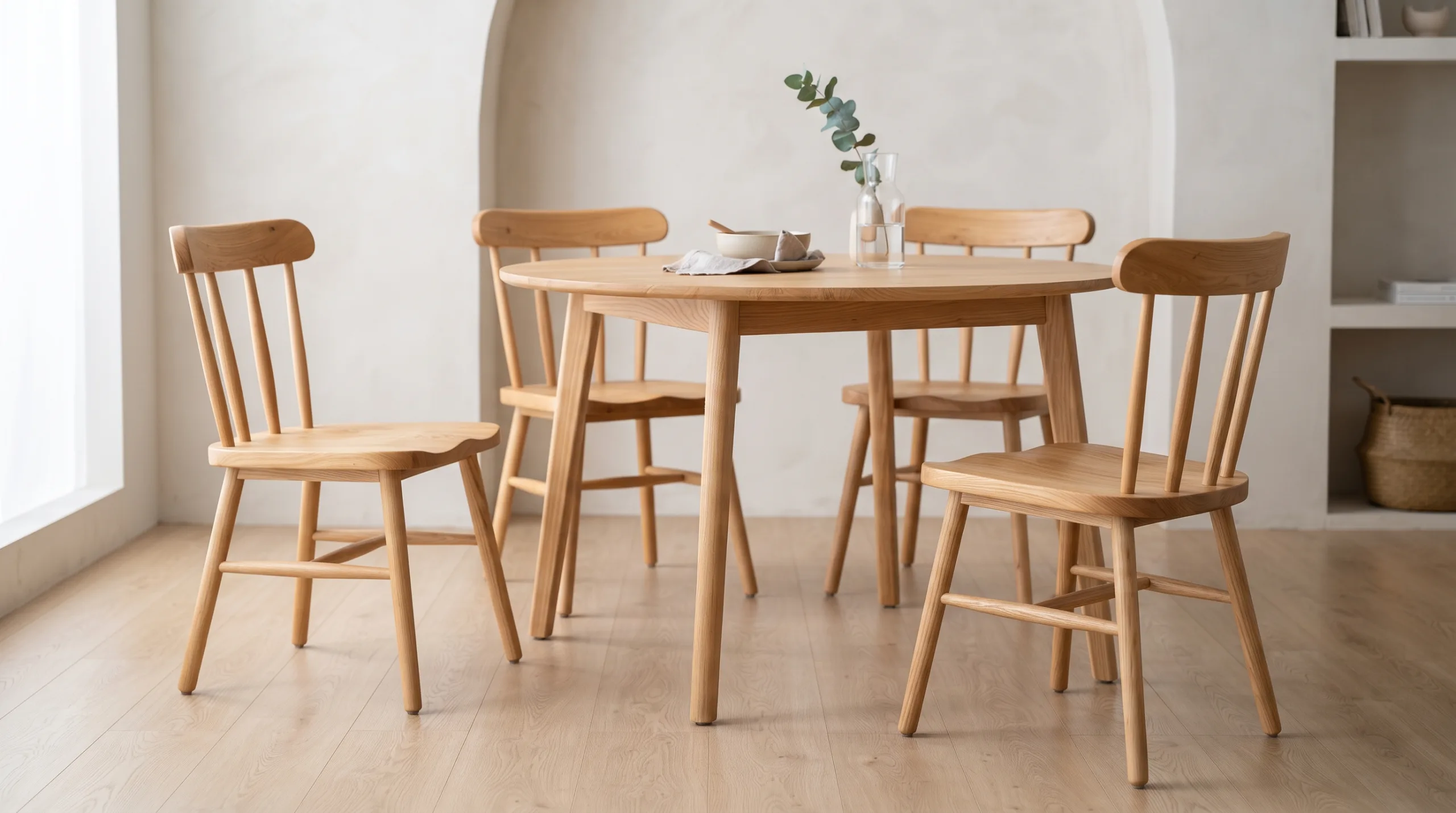
Trends in contract furniture move more slowly than in consumer goods, but they do move — and 2026 is the year several of them arrived at once. This guide covers the five design directions shaping mindi wood custom chairs this year, and, for each one, what it actually changes on the drawing board: section sizes, radii, joinery, finish systems and how a chair packs into a container.
The five below recurred independently in briefs from European, North American and Australian buyers. None of them is a styling exercise: each one changes cost, tooling or packaging, which is why they are worth reading before the moodboard rather than after it.
1. Sustainability that shows up on the specification sheet
Provenance has moved off the marketing page and onto the specification sheet. Buyers now ask for a stated origin per production batch, a species name rather than a trade name, and a finish system that meets EU limits on volatile organic compounds. The design consequence is simple: fewer exotic veneers, more solid timber that can be documented.
Repairability is the second half of the same conversation. A chair built so that a back leg or a spindle can be unbolted and replaced survives a decade of hotel use; one that is glued shut does not. Mindi’s straight, predictable grain makes that repairable construction practical, because a replacement part can be machined to match an existing frame months later.
2. Modular mindi wood custom chairs and the cost of air
Floor areas in Singapore, Amsterdam and Melbourne apartments keep shrinking, and the answer buyers ask for is no longer “a foldable chair” but “a chair that changes shape for the trip”. Stacking height, crate volume and leg attachment now sit on the moodboard next to the silhouette itself.
In production that means six-high stacking instead of four, legs that detach on a single bolt so a 40HQ container carries more seat frames, and a shared seat shell across two or three backrest designs — so a retailer can present a family instead of a single SKU. On mindi wood custom chairs the saving shows up at crating: a nested frame set packs into fewer cartons, which is often the difference between two container loads and three.
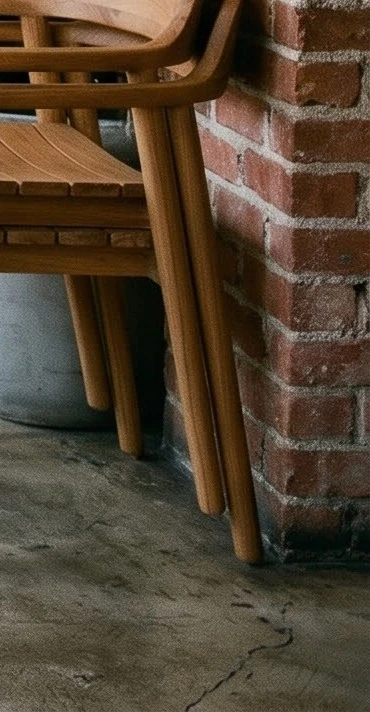
3. Customisation measured in millimetres, not colour chips
Customisation has moved away from colour swatches and towards proportion. The requests that arrive most often are not new finishes but new dimensions: a 46 cm seat height for a specific dining table, a deeper seat for lounge use, a narrower back for banquette seating.
That is the harder kind of customisation, because it touches tooling. Mindi helps here — it machines cleanly at small batch sizes, so a run of sixty chairs in a non-standard depth is workable in a way it would not be in a denser, more abrasive hardwood. Hand-carved details remain available for buyers who want a signature motif, but they are specified per project rather than stocked.
4. Organic shapes and where the joinery hides
Soft geometry is still the dominant visual language: radiused seat edges, backs that curve in plan as well as in elevation, arm profiles that taper instead of stopping. The design work sits in the transition points, where a curved back meets a straight rail.
Two production routes are open. CNC cutting from solid stock gives repeatability and holds a tight radius; steam bending gives a continuous grain line through the curve but constrains the section. Most briefs we produce this year combine both — CNC for seat and back, bent or laminated elements only where the grain has to follow the shape.
5. Dark finishes and the blotching problem
Espresso, charcoal and smoked-oak tones remain the fastest-growing finish family, and the difficulty is not the colour but the blotching. Mindi takes stain unevenly across the growth rings unless the surface is sealed first; the sequence that works is a sanding schedule to 180 grit, a wash coat, the stain, then an open-pore lacquer.
Wire-brushing before staining is what separates a convincing dark finish from a flat one — it opens the softer early wood so the grain reads through the colour. It also adds a handling step per component, worth flagging at quotation stage rather than discovering during production.
From trend to production-ready design
A trend only becomes a product when it survives three gates. The first is dimension: seat height, depth, back angle and stacking clearance fixed against the tables and the rooms the chair will live in.
The second is construction: which joints carry load, where the chair is expected to flex, and which parts a hotel maintenance team will need to replace. We propose the joint schedule at sample stage, not after approval.
The third is logistics: how many units fit a container once legs are detached or nested, and which packaging protects a curved back without adding volumetric weight. Crate planning usually changes a design more than the styling does.
What to send with a design enquiry:
- Three to five reference images, with a note on what you like in each
- Intended use — residential, hospitality or contract — and expected volume
- Seat height, seat depth and any fixed dimension from the table it pairs with
- Finish direction, including whether grain has to read through a dark stain
- Target market and any compliance requirement the chair must meet
Conclusion
Taken together, the five directions point the same way: chairs that are documented, repairable, transportable in fewer crates and adaptable in proportion. None of that is decorative, and all of it is decided before the first sample is cut. Mindi is not the right material for every brief, but for trend-led indoor collections it removes most of the usual friction — it takes dark stains convincingly, holds a tight radius, machines at small batch sizes and keeps a repairable frame affordable.
The practical advice for 2026 is to design the trend into the construction rather than onto the surface. A repairable joint and a stackable frame will still look current in five years; a decorative flourish will not. How those designs are produced at volume — kiln drying, joint schedules, quality control and export documentation — is covered on our mindi wood manufacturer and exporter page.
Start with a reference board
Send three or four images, the intended seat height, the finish direction and the volume you expect per year. That is usually enough to tell you within a week whether a design is straightforward, and where the cost will sit — before anyone draws it. Use the request a quote form and we will come back with a moodboard, a physical finish sample set and a first view on construction.
Questions buyers ask about mindi wood custom chairs
What is the minimum order for mindi wood custom chairs?
A trial order of about 100 chairs is workable when the design uses existing tooling. Below that, the sample and setup cost dominates the unit cost, so it is usually better to start with a small mixed container across two or three models.
Which finish systems work best on this timber?
Water-based lacquer and hardwax oil both behave well. On darker tones, wire-brushing before staining keeps the grain from blotching, and a two-coat sealer prevents the finish from looking flat under warm lighting.
How long does a custom chair programme take?
Sampling runs two to three weeks, and production after approval typically takes 60 to 90 days depending on finishing and hardware. Seasonal programmes are scheduled backwards from the retail floor date, including ocean transit.