
Complete Guide to Indonesian Wooden Chair Design & Manufacturing (2026)
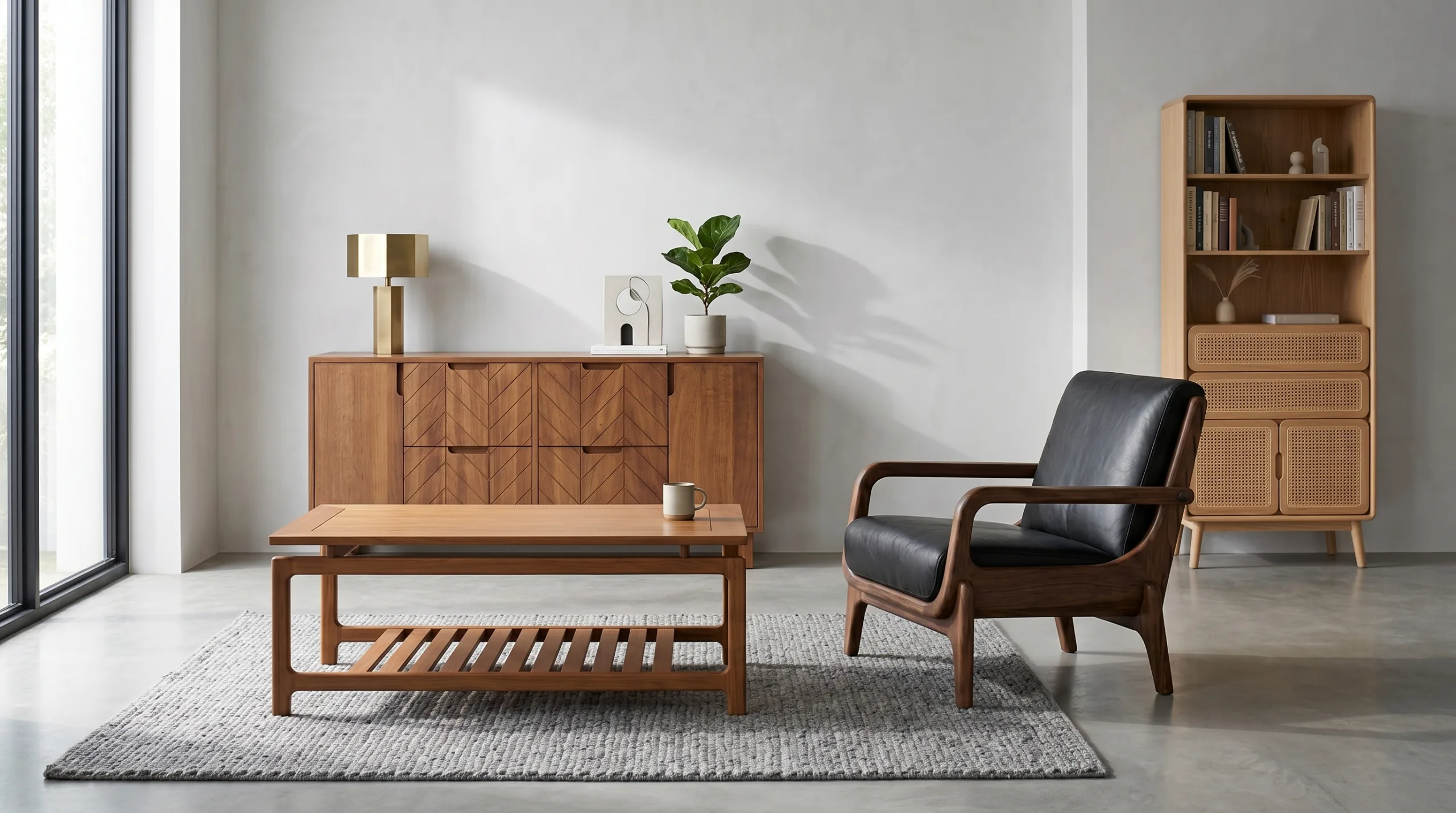
Indonesia has been the world’s largest teak exporter for centuries, and in 2026, the country’s wooden chair manufacturing industry continues to set the standard for quality, craftsmanship, and value.
From the teak forests of Central Java to the rattan workshops of Bali, Indonesian artisans and manufacturers produce chairs that serve hotels, restaurants, and homes across Australia, the United States, the Middle East, and Europe.
For importers and furniture buyers, understanding the indonesian wooden chair design guide is essential.
The industry offers a unique combination of premium materials — including teak, mindi, rattan, and leather — alongside modern manufacturing capabilities that meet international export standards.
Whether you are sourcing dining chairs for a hotel chain or looking for a reliable wholesale supplier, this comprehensive guide covers everything from material selection to the complete indonesian chair manufacturing process.
Why Indonesian Chairs Dominate Global Markets
Indonesia’s position in the global furniture market comes down to three factors:
- Material Access — Indonesia controls roughly 40% of the world’s teak plantation stock, with certified sustainable forests managed under the SVLK (Sistem Verifikasi Legalitas Kayu) system. Teak (Tectona grandis) remains the gold standard for durable outdoor and dining furniture, while mindi wood offers a cost-effective alternative for indoor applications.
- Craftsmanship Heritage — Javanese joinery techniques, passed down through generations, allow manufacturers to produce chairs without excessive reliance on metal fasteners. This results in cleaner aesthetics and stronger structural integrity — a key selling point for premium buyers.
- Export-Ready Infrastructure — Indonesian manufacturers, particularly in Central Java (Solo, Jepara, Kudus), have developed production capabilities that meet international standards, including SVLK certification, ISPM-15 compliant packaging, and container-optimized designs.
Who This Guide Is For
This guide is written for:
- Furniture importers looking for reliable Indonesian manufacturers
- Hotel and hospitality procurement teams sourcing dining and lounge chairs
- Wholesale buyers evaluating MOQ, lead times, and customization options
- Interior designers seeking authentic Indonesian furniture with export capabilities
By the end of this article, you will understand the complete spectrum of Indonesian wooden chair options — from teak to mindi, from hand-carved Balinese styles to modern minimalist designs — and how to source them efficiently.
1. Material Guide: Indonesian Wooden Chair Design Guide — Teak, Mindi, Rattan & Leather Compared
Choosing the right material is the most critical decision in wooden chair sourcing. Each material offers distinct properties in terms of durability, aesthetics, weight, and price point. Below is a comprehensive comparison to help importers and buyers make informed decisions.
Material Comparison Table
| Material | Durability | Weight | Price Tier | Indoor/Outdoor | Best For |
|---|---|---|---|---|---|
| Teak | Excellent (25+ years outdoor) | Heavy (550-650 kg/m³) | Premium ($$$) | Both | Dining chairs, outdoor furniture, hotel furniture |
| Mindi | Good (10-15 years indoor) | Medium (450-550 kg/m³) | Mid-range ($$) | Indoor | Dining chairs, bedroom furniture, office |
| Rattan | Good (with proper treatment) | Light (80-120 kg/m³) | Mid-range ($$) | Both (synthetic: outdoor) | Lounge chairs, accent chairs, outdoor sets |
| Leather | Excellent (with maintenance) | Heavy (depends on frame) | Premium ($$$) | Indoor | Executive chairs, dining chairs, lounge |
| Synthetic rattan (wicker weave) | Good (synthetic: excellent) | Light (depends on frame) | Mid-range ($$) | Both (synthetic: outdoor) | Dining chairs, outdoor sets, hospitality |
Teak Wood — The Premium Standard
Teak (Tectona grandis) remains the most sought-after material for Indonesian wooden chairs. Its natural oils make it resistant to rot, insects, and weathering — ideal for both indoor and outdoor applications.
Key Properties:
- Density: 550-650 kg/m³ (varies by plantation age)
- Janka Hardness: 1,070 lbf (medium-hard)
- Natural oils: Provide water resistance without chemical treatment
- SVLK Certified: All export teak must carry SVLK legality certification
Grading System:
- Grade A (Heartwood Only): Minimum 15 years old plantation, rich golden-brown color, visible grain, maximum oil content. Best for premium furniture and export.
- Grade B (Heartwood + Sapwood Mix): 10-15 years old, lighter color, less consistent grain. Suitable for mid-range furniture.
- Grade C (Sapwood Dominant): Younger plantation, pale color, lower oil content. Used for budget furniture or painted finishes.
For importers: always request Grade A teak for hospitality and outdoor furniture. Grade B is acceptable for painted or stained indoor furniture.
→ Read more: Teak Wood Benefits: Why It’s the Best Material for Dining Chairs
Mindi Wood — The Affordable Alternative
Mindi (Melia azedarach) is Indonesia’s most popular alternative to teak for indoor furniture. It offers good workability at a significantly lower price point, making it ideal for wholesale dining chairs and volume production. For a full comparison, see our best wood for furniture making guide, mindi vs teak mahogany oak comparison, and mindi wood durability specs.
Important Note: Unlike teak, mindi wood has no formal A/B/C grading system. Quality is determined by physical factors rather than industry-standard grades.
Quality Factors (Instead of Grades):
| Factor | High Quality | Medium Quality | Low Quality |
|---|---|---|---|
| Grain pattern | Straight, consistent | Slightly wavy | Irregular, knots |
| Color consistency | Uniform golden-brown | Light variation | Dark streaks, patches |
| Moisture content | 8-12% (kiln-dried) | 12-15% | >15% (risk of warping) |
| Density | 500-550 kg/m³ | 450-500 kg/m³ | <450 kg/m³ |
| Insect treatment | Borax-boric acid treated | Untreated | No treatment |
Why No A/B/C Grades? Teak has an internationally recognized grading system because it is a high-value export commodity. Mindi is primarily a domestic material used for mid-range furniture, so no standardized grading system has been developed. Buyers should evaluate quality based on the physical factors above.
What the tiers mean in practice:
- Teak: the premium tier — the top of the market, and the timber we recommend for open outdoor exposure.
- Mindi: the affordable tier — the value pick for indoor volume programs, and far below teak on raw material.
- The real point: on finished furniture the gap narrows, because design, joinery, finishing and freight make up most of the total. There is no fixed ratio.
→ Read more: Is Mindi Wood Expensive? What Actually Drives the Cost
Rattan — Lightweight Versatility
Rattan is a naturally renewable vine that grows abundantly in Indonesian forests. It is valued for its flexibility, lightweight nature, and natural aesthetic.
Types:
- Natural Rattan: Hand-woven, traditional appearance, suitable for indoor use
- Synthetic Rattan (PE Rattan): Weather-resistant, UV-stable, ideal for outdoor furniture
Properties:
- Density: 80-120 kg/m³ (very lightweight)
- Flexibility: Can be bent and shaped when steamed
- Indoor/Outdoor: Natural = indoor only; Synthetic = both
Best Applications:
- Lounge chairs and accent chairs
- Dining chairs with rattan backrest
- Outdoor furniture (synthetic rattan only)
→ Read more: Rattan Armchair Manufacturer: Wholesale Options
Leather — Premium Upholstery
Leather chairs combine wooden frames (typically teak or mindi) with premium upholstery. The leather type significantly affects durability, maintenance, and price.
Leather Types:
| Type | Durability | Maintenance | Price | Best For |
|---|---|---|---|---|
| Full-grain | Excellent (15+ years) | High (regular conditioning) | Premium | Executive, luxury dining |
| Top-grain | Very Good (10-15 years) | Medium | High | Hospitality, upscale dining |
| Bonded leather | Good (5-8 years) | Low | Mid-range | Budget hospitality, offices |
| Faux leather (PU) | Good (5-10 years) | Very Low | Budget | High-traffic areas |
Wicker — Traditional Weaving Craftsmanship
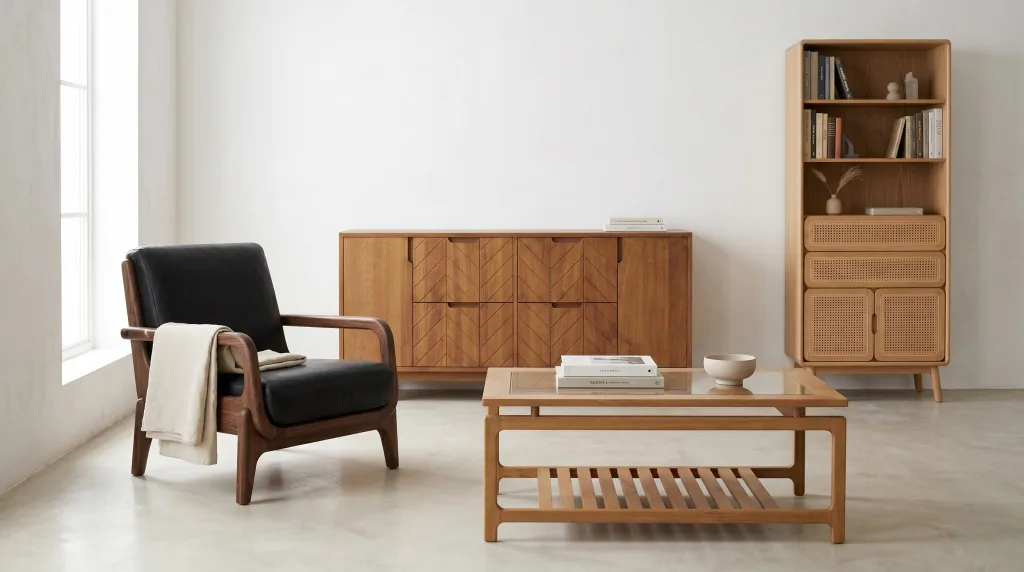
Wicker refers to the weaving technique rather than the material itself. Indonesian wicker chairs can be made from rattan, bamboo, or synthetic fibers woven over a wooden or metal frame.
Natural vs Synthetic Rattan Weave:
| Feature | Natural rattan (wicker weave) | Synthetic rattan (wicker weave) |
|---|---|---|
| Appearance | Traditional, organic | Modern, uniform |
| Durability | 5-10 years indoor | 10-15 years outdoor |
| Weather resistance | Low (indoor only) | High (UV, rain resistant) |
| Weight | Very light | Light |
| Price | Mid-range | Mid-range |
Best Applications:
- Indoor dining chairs (natural rattan weave)
- Outdoor patio furniture (synthetic rattan weave)
- Hospitality lounge areas
2. Design Guide: Dimensions, Ergonomics & Regional Styles
Indonesian wooden chairs come in a wide variety of designs, from traditional hand-carved Javanese styles to modern minimalist forms. Understanding wooden chair design standards helps importers select products that meet both aesthetic preferences and functional requirements.
Dining Chair Dimensions — Industry Standards
The following dimensions are widely accepted as standard for dining chairs manufactured in Indonesia:
| Measurement | Standard Range | Notes |
|---|---|---|
| Seat Height | 45-48 cm (17.7-18.9 in) | Must match table height (75-78 cm) |
| Seat Width | 45-50 cm (17.7-19.7 in) | Minimum for comfortable dining |
| Seat Depth | 40-45 cm (15.7-17.7 in) | Allows backrest support |
| Back Height | 85-95 cm (33.5-37.4 in) | From floor to top of backrest |
| Backrest Height | 35-45 cm (13.8-17.7 in) | From seat to top of backrest |
| Armrest Height | 20-25 cm (7.9-9.8 in) | From seat surface (if applicable) |
| Weight | 4-7 kg | Varies by material and design |
Key Principle: The relationship between seat height and table height is critical. A standard dining table is 75-78 cm tall; therefore, the seat should be 45-48 cm to allow 27-33 cm of clearance for legroom.
Ergonomic Principles
Modern Indonesian manufacturers increasingly incorporate ergonomic design principles, particularly for chairs destined for hospitality and office markets.
Four Pillars of Chair Ergonomics:
- Seat Height — Adjusted to user’s popliteal height (floor to underside of knee). For dining chairs, 45-48 cm accommodates most adults.
- Seat Depth — Should allow 2-3 finger widths between the front edge of the seat and the back of the knee. Too deep: user cannot reach backrest. Too shallow: insufficient thigh support.
- Backrest Angle — Optimal angle is 95-105° from the seat. This promotes upright posture while allowing slight recline for comfort during extended dining.
- Lumbar Support — The backrest should have a gentle curve at lumbar height (20-25 cm above seat) to support the natural S-curve of the spine.
Regional Design Styles
Indonesian wooden chairs reflect the country’s diverse cultural heritage. Each region has developed distinct design characteristics:
Java (Central & East Java)
- Characteristics: Clean lines, minimal ornamentation, functional focus
- Joinery: Mortise-and-tenon joints, minimal metal hardware
- Best for: Modern hotels, restaurants, minimalist interiors
- Popular styles: Jengki (mid-century), Minimalis, Klasik Sederhana
Balinese
- Characteristics: Intricate carvings, floral motifs, spiritual symbolism
- Joinery: Traditional wooden pegs, hand-carved details
- Best for: Resort furniture, boutique hotels, cultural-themed spaces
- Popular styles: Patra (flower motif), Karang Boma (demon face), Baroque-inspired
Lombok (West Nusa Tenggara)
- Characteristics: Rustic, natural finish, geometric patterns
- Joinery: Simple but sturdy, often with exposed wood grain
- Best for: Eco-resorts, beach hotels, rustic-themed restaurants
- Popular styles: Sasak-inspired, Natural Finish, Rustic Modern
Modern Minimalist
- Characteristics: Geometric forms, monochromatic finishes, industrial touches
- Joinery: Metal-wood combinations, hidden fasteners
- Best for: Urban restaurants, contemporary hotels, co-working spaces
- Popular styles: Scandinavian-inspired, Industrial, Japanese-Indonesian fusion
Design Trends in 2026
- Mixed Materials — Teak frames with leather upholstery, rattan backrests with mindi seats
- Natural Finishes — Matte, oil-finished surfaces over glossy lacquer
- Stackable Designs — Growing demand for space-saving hospitality chairs
- Sustainable Certifications — SVLK and FSC certifications increasingly required by importers
- Custom Color Finishes — Stain and paint options beyond natural wood tones
Want to learn more about wooden chair guides?
You might find these articles helpful:
-
Best Wood for Outdoor Chairs (2026): Why Teak Outlasts Suar & Mindi
Choosing the best wood for outdoor chairs is not a matter of taste — it is a matter of survival. We build more than 10,000…
-
Wholesale Dining Chairs Manufacturer Indonesia — Teak, Mindi & Custom
Wholesale Dining Chairs Manufacturer Indonesia — Teak, Mindi & Custom Indonesia has long been recognized as one of the world’s premier sources of wooden furniture,…
-
Mindi Wood vs Other Woods: Best Choices for Custom Chair Furniture
Mindi vs Teak vs Mahogany vs Oak Wood: Best Choices for Wooden Custom Chairs Have you ever sat in your favorite wooden chair, feeling its…
-
Indonesia Teak Leather Chair Furniture Manufacturer
Indonesian Teak Leather Chairs. We are an Indonesian teak leather chairs manufacturer and supplier. Teak leather chair is one of our most ordered productions by…
-
Teak Rattan Chair Manufacturer Indonesia — Wholesale & Custom (2026)
Indonesia Teak Rattan Chairs. We are an Indonesian teak rattan chairs furniture manufacturer and supplier. We are a teak rattan chair maker from Indonesia. We…
-
Indonesia Teak Synthetic Rattan Chair Furniture Manufacturer and Supplier
We are an Indonesian manufacturer of teak chairs in natural and synthetic rattan weave and supply worldwide.
-
Indonesian Wooden Chair Manufacturer and Exporter
Indonesian Wooden Chair Manufacturer. We are an Indonesian furiture manufacturer that make wooden chairs that are proven to have high market demand. We are an…
-
Indonesian Stackable Wooden Chairs Manufacturer and Supplier
Indonesian Wooden Stackable Chairs: The Best Strategy for Importers to Increase Profits. Stackable wooden chairs allow for more space efficiency. Importers will get more profit…
-
Ideal Dining Chair Size for Dining Table.
Choosing the best teak dining chair design is not only seen from the aesthetic side. The size of the dining chair is important because, with…
3. Manufacturing Overview: Step-by-Step from Design to Export
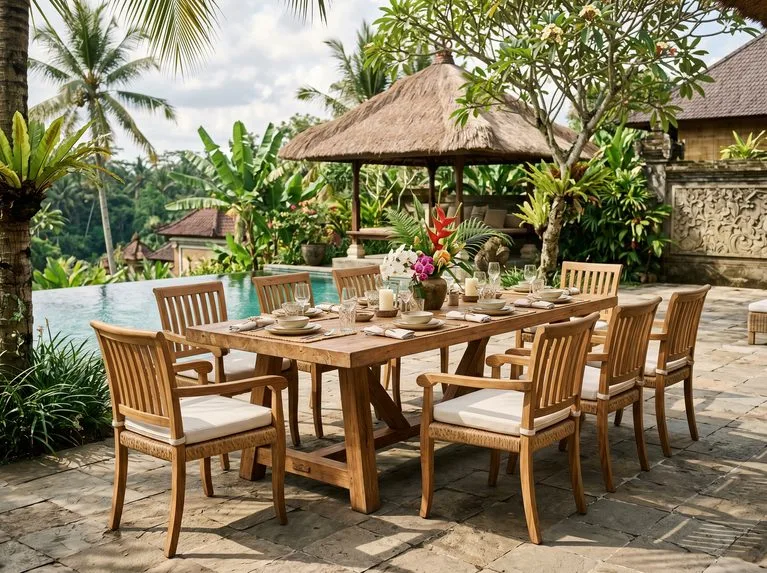
The chair manufacturing process in indonesia follows a systematic workflow from initial consultation to final export. This section provides a transparent overview of how Indonesian manufacturers — including Tertuju’s workshops in Sukoharjo — produce wooden chairs for international markets.
The 9-Step Manufacturing Process
Step 1: Client Consultation
- Product requirements (dimensions, material, finish, quantity)
- Design brief or reference images
- Budget and timeline discussion
- MOQ confirmation
Step 2: Design & Prototyping
- Technical drawings (CAD or hand-drawn)
- Material selection and approval
- Prototype production (1-2 pieces)
- Client review and revisions
Timeline: 1-2 weeks for standard designs, 2-3 weeks for custom prototypes.
Step 3: Material Sourcing & Preparation
- Wood procurement (teak, mindi, rattan) from certified suppliers
- SVLK verification for all teak materials
- Kiln drying to target moisture content (8-12%)
- Quality inspection of raw materials
Step 4: Cutting & Shaping
- CNC precision cutting for standard components
- Hand-cutting for custom or ornate designs
- Component sorting by grain direction and quality
- Waste minimization through optimized cutting patterns
Step 5: Joinery & Assembly
- Traditional mortise-and-tenon joints (preferred for durability)
- Wooden dowels and pegs (no excessive metal hardware)
- Glue application (waterproof, food-safe adhesives)
- Clamping and curing (24-48 hours)
Key Quality Indicator: Indonesian manufacturers are known for clean joinery — minimal visible fasteners, tight joints, and structural integrity without excessive metal reinforcement.
Step 6: Sanding & Surface Preparation
- Progressive sanding (80 → 120 → 180 → 220 grit)
- Hand-sanding for carved or detailed areas
- Dust removal and surface inspection
- Filling any gaps or imperfections
Step 7: Finishing
- Natural finish: Oil-based (teak oil, linseed oil) — preserves wood grain
- Lacquer finish: Polyurethane or melamine — provides protective coat
- Paint finish: Primer + paint — for custom colors
- Stain finish: Wood stain + topcoat — enhances grain while adding color

Step 8: Quality Control
- Dimensional accuracy check (±2mm tolerance)
- Structural stability test (weight-bearing, wobble test)
- Surface finish inspection (no runs, drips, or bare spots)
- Color consistency across batch
- Final cleaning and packaging preparation
Step 9: Packaging & Export
- Individual chair wrapping (foam + bubble wrap)
- Corner protection (cardboard or foam)
- Carton packing (2-4 chairs per carton)
- Container loading optimization (40HC specifications)
Container Loading Estimates:
| Chair Type | Pieces per 40HC | Notes |
|---|---|---|
| Stackable dining chairs | 800-1,000 | Stacked vertically |
| Standard dining chairs | 400-500 | Nested/stacked |
| Lounge chairs | 200-300 | Bulkier, less stacking |
| Armchairs | 150-250 | Largest footprint |
| Bar stools | 500-700 | Stackable designs |
Tertuju’s Manufacturing Capabilities
Generally, Tertuju works on three specialization:
- Dining chairs, armchairs, custom chairs furniture
- Leather, rattan, and wicker-weave chairs
- Stackable chairs, knockdown chairs, bulk production
Lead Time Expectations
| Order Type | Est. Production Time | Est. Shipping (SEA) | Est. Shipping (AU/EU/US) |
|---|---|---|---|
| Standard catalog | 8-10 weeks | 2-3 weeks | 4-6 weeks |
| Custom design | 10-12 weeks | 2-3 weeks | 4-6 weeks |
| Large volume (1,000+) | First container production takes about 8–10 weeks, and subsequent containers are shipped on a monthly basis. | 2-3 weeks | 4-6 weeks |
Estimation of total door-to-door:
- Standard + SEA shipping: 8-11 weeks
- Standard + AU/EU/US shipping: 10-14 weeks
- Custom + AU/EU/US shipping: 14-18 weeks
4. Product Types: Rattan, Leather & Upholstered Chairs
Indonesian manufacturers produce a diverse range of chair types beyond standard wooden dining chairs. Understanding each category helps importers match products to their market needs.
Wicker Chairs
Wicker refers to the weaving technique, not the material. Indonesian wicker chairs use rattan, bamboo, or synthetic fibers woven over wooden or metal frames.
Natural Rattan & Bamboo Weave:
- Hand-woven by skilled artisans
- Indoor use only (natural fibers degrade outdoors)
- Traditional aesthetic, cultural appeal
- Lightweight (2-4 kg per chair)
Synthetic Rattan Weave (PE/HDPE):
- Machine-woven or hand-woven over aluminum frames
- UV-resistant, weatherproof, 10+ year outdoor life
- Easy maintenance — hose down to clean
- Popular for resort and patio furniture
Best-Selling Rattan Weave Styles:
| Style | Frame Material | Weaving Material | Best For |
|---|---|---|---|
| Bistro Chair | Teak/Mindi | Natural rattan | Cafés, indoor dining |
| Lounge Chair | Aluminum | PE rattan | Poolside, terrace |
| Dining Armchair | Teak | Synthetic rattan | Outdoor dining |
| Egg Chair | Steel | PE rattan | Resort, luxury outdoor |
→ Read more: Wicker Chair Collection
Rattan Chairs
Rattan is the raw vine material; wicker is the weaving technique used to shape it into furniture. Rattan chairs specifically highlight the natural vine as a structural and decorative element.
Construction Methods:
- Full Rattan Frame: Entire chair made from rattan poles (very lightweight, indoor only)
- Wood Frame + Rattan Back/Seat: Teak or mindi frame with rattan panel inserts
- Rattan Wrapping: Wood frame fully wrapped in rattan skin
Popular Rattan Chair Types:
| Type | Frame | Rattan Use | Application |
|---|---|---|---|
| Medan Chair | Teak | Backrest panel | Dining, hospitality |
| Peacock Chair | Rattan poles | Full frame | Statement piece, lounge |
| Rattan Dining Chair | Mindi | Seat + back | Volume dining |
| Rattan Lounge Chair | Teak | Backrest + arms | Resort, living room |
Durability Note: Natural rattan requires borax-boric acid treatment to prevent insect damage. Synthetic rattan (PE) eliminates this concern.
Leather & Upholstered Chairs
Leather chairs combine solid wood frames with premium upholstery. The frame wood choice affects both aesthetics and price.
Frame Wood Options:
- Teak Frame + Leather: Premium tier, outdoor-capable frame, luxury appeal
- Mindi Frame + Leather: Mid-range, indoor only, cost-effective
- Mahogany Frame + Leather: Traditional look, darker tone, mid-premium
Upholstery Options:
| Upholstery | Durability | Maintenance | Cost | Best For |
|---|---|---|---|---|
| Full-grain leather | 15+ years | High (conditioning) | Premium | Executive, fine dining |
| Top-grain leather | 10-15 years | Medium | High | Hotel restaurants |
| Performance fabric | 7-10 years | Low | Mid-range | High-traffic hospitality |
| Faux leather (PU) | 5-8 years | Very Low | Budget | Budget hotels, offices |
Customization Available:
- Leather color matching (Pantone/RAL)
- Stitching patterns (French seam, piping, tufting)
- Foam density (firm, medium, soft)
- Fire-retardant treatment (UK/US standards)
→ Read more: Leather Chairs Manufacturer
Stackable & Space-Saving Chairs
Growing demand from hotels, banquet halls, and co-working spaces for stackable designs.
Key Features:
- Storage efficiency
- Nesting design (seat lifts to nest)
- Lightweight (3-5 kg) for easy handling
- Reinforced joints for repeated stacking/unstacking
Container Loading Advantage:
- Standard dining: 200-300 pcs/40HC
- Stackable dining: 400-600 pcs/40HC
- 2x density means far fewer containers per order
→ Read also: Stackable chairs collection
5. Buying Guide for Importers: MOQ, Lead Time, Shipping & Customization
This section addresses the practical questions every importer faces when sourcing Indonesian wooden chairs.
Minimum Order Quantities (MOQ)
MOQ varies by product complexity and customization level.
However, in general, we accept container-based orders. The minimum order is 6 pieces per item, and mixed items are allowed.
Lead Time Breakdown
Standard Catalog Orders (8 weeks production):
- Week 1-2: Material procurement & drying
- Week 3-4: Cutting, joinery, assembly
- Week 5-6: Sanding & finishing
- Week 7-8: QC, packaging, container loading
Custom Design Orders (10-12 weeks production):
- Week 1-3: Design finalization, prototyping, approval
- Week 4-5: Material sourcing for custom specs
- Week 6-9: Production run
- Week 10-12: Finishing, QC, packaging
Buffer: Add 2 weeks for peak season (Aug-Oct, pre-Christmas).
Shipping & Container Optimization
Incoterms Offered:
- FOB Semarang/Surabaya (most common)
- CIF Destination Port
- DDP (door-to-door, select countries only)
Container Specifications:
| Container | Max Weight | Volume | Best For |
|---|---|---|---|
| 20GP | 21,000 kg | 33 m³ | Small orders, heavy teak |
| 40GP | 26,000 kg | 67 m³ | Standard furniture |
| 40HC | 26,000 kg | 76 m³ | Optimal — max volume for chairs |
Customization Options
Tertuju offers extensive customization for B2B clients:
- Custom dimensions.
- Selection of wood materials.
- Selection of finish types and colors.
- Combining wood with other materials such as rattan, leather, and fabric.
- Special hardware requests.
- Branding applied to the product or packaging.
- Custom packaging.
Payment Terms
- FOB: a deposit with the order, with the balance against a copy of the Bill of Lading
- Large volume (1,000+): Negotiable
How to Request a Quote
Prepare your requirements:
- Product type(s) and quantity (better with photo references)
- Material preferences (teak/mindi/rattan/leather)
- Finish/color requirements
Click here to drop your inquiry.
Common Pitfalls to Avoid
| Pitfall | Solution |
|---|---|
| Not specifying indoor/outdoor use | Always state application — determines material & finish |
| Ignoring moisture content | Require 8-12% kiln-dried certification |
| Skipping prototype for custom designs | Always approve prototype before full production |
| Underestimating lead time | Add 2-3 week buffer for holidays/shipping |
| Not checking SVLK for teak | Mandatory for legal export — request certificate |
Conclusion
Indonesian wooden chairs represent the convergence of centuries-old craftsmanship, premium natural materials, and modern export-ready manufacturing. Whether you need teak dining chairs for a luxury resort in Bali, mindi stackable chairs for a hotel chain in Australia, or custom rattan lounge chairs for a restaurant in Dubai — Indonesia delivers quality, value, and reliability.
Key Takeaways:
- Teak = premium, outdoor-capable, SVLK certified
- Mindi = affordable indoor alternative, no formal grades
- Rattan (natural & synthetic) = lightweight, versatile, indoor/outdoor options
- Manufacturing = 9-step process, mortise-and-tenon joinery, 6-12 week lead times
- Customization = dimensions, finishes, upholstery, branding
- Export = ISPM-15 compliant, 40HC optimized, global shipping
Ready to source Indonesian wooden chairs for your next project?
FAQs
What is the mindi wood grade system?
Unlike teak, mindi wood has no formal A/B/C grading system. Quality is evaluated by physical factors: grain consistency, color uniformity, moisture content (8-12% ideal), density (500-550 kg/m³), and insect treatment. Always request kiln-dried certification and inspect samples.
What are standard dining chair dimensions?
Seat height 45-48 cm, seat width 45-50 cm, seat depth 40-45 cm, total back height 85-95 cm. These match standard 75-78 cm dining table heights with 27-33 cm legroom clearance.
Teak vs mindi for export — which should I choose?
Teak for outdoor, hospitality, premium markets (25+ year durability, SVLK certified). Mindi for indoor, volume dining, budget-conscious projects (a lower material cost, 10-15 year indoor life). Both are export-compliant when properly sourced.
What is the MOQ for wholesale dining chairs?
Standard catalog: 50 pieces per design/color. Custom designs: 20 pieces. Stackable chairs: 100 pieces standard, 50 pieces custom. Mixed containers allowed (e.g., 50 dining + 30 lounge).
What is the lead time for custom orders?
10-12 weeks production + 4-6 weeks shipping (AU/EU/US) = 14-18 weeks door-to-door. Standard catalog: 6-8 weeks production. Add 2 weeks buffer for Aug-Oct peak season.
What is SVLK certification and why does it matter?
SVLK (Sistem Verifikasi Legalitas Kayu) is Indonesia’s mandatory timber legality verification system. All teak exports require SVLK certification to legally enter EU, US, Australia, Japan, and other regulated markets. It proves the wood comes from legal, sustainably managed sources.
How many chairs fit in a 40HC container?
Stackable dining: 800-1,000 pcs. Standard dining: 400-500 pcs. Lounge chairs: 200-300 pcs. Armchairs: 150-250 pcs. Bar stools: 500-700 pcs. Exact count depends on dimensions and packaging.
What is the difference between rattan and wicker?
Rattan is the natural vine material (Calamus spp.). Wicker is the weaving technique. A “rattan chair” uses rattan as material; a “wicker chair” can use rattan, synthetic resin, or other materials woven in wicker style.
How do I maintain leather dining chairs?
Full-grain leather: condition every 3-6 months with leather conditioner. Wipe spills immediately. Avoid direct sunlight and heat sources. Top-grain: similar care but less frequent conditioning. Bonded leather: wipe with damp cloth only.
How do I request a quote from Tertuju?
Fill the quote form by clicking the button provided or email info@tertuju.com with: product type, quantity, material, finish, destination, and timeline. Response within 24 hours.
What shipping options are available to [AU/US/UAE/EU]?
FOB Semarang/Surabaya (standard), CIF destination port, or DDP door-to-door (select countries). SEA: 2-3 weeks. AU/EU/US: 4-6 weeks. All wood packaging ISPM-15 compliant.
What is your quality control process?
5-stage QC: (1) Raw material inspection, (2) Dimensional check (±2mm), (3) Structural stability test, (4) Finish inspection, (5) Pre-shipping container check. Photos/video provided before shipment. Third-party inspection (SGS, Bureau Veritas) welcome at buyer’s cost.
Related: How to Design Teak Wooden Dining Chairs
Related: Learn about the best wood for outdoor chairs — a direct comparison of teak, suar, and mindi from a manufacturer workshop.